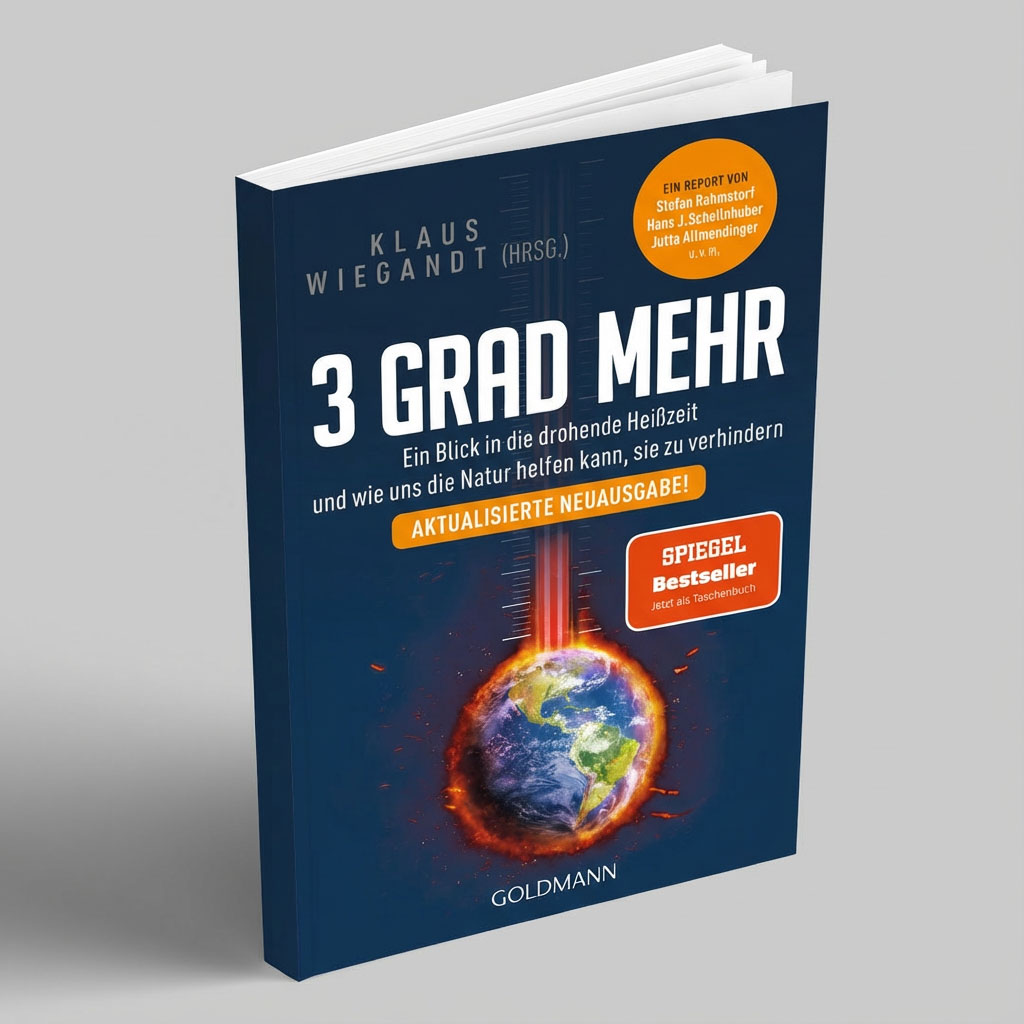
Authors
Prof. Dr. h. c. Jutta Allmendinger, Ph. D., is President of the Social Science Research Center Berlin (WZB), Professor at Humboldt University and Honorary Professor at Freie Universität Berlin. She was previously a professor at the Ludwig Maximilian University of Munich and Director of the Institute for Employment Research at the Federal Employment Agency in Nuremberg.
Dina Ionesco is co-director of the new Master’s Program in Migration, Climate Change and Environment (MAMCE) at Webster University in Geneva and works as a manager at the Secretariat of the United Nations Framework Convention on Climate Change (UNFCCC). Previously, she headed the Migration, Environment and Climate Change Division at the United Nations Migration Agency (IOM).
Prof. Dr. Hans Joosten is a biologist and professor emeritus of peatland science and paleoecology at the University of Greifswald. He is co-founder of the Greifswald Mire Center, which sees itself as an expert forum, think tank and interface between science, politics and practice. In 2021, he was awarded the prestigious German Environmental Prize for his peatland research and his commitment to communicating the importance of peatlands to the general public.
Dr. Bernhard Kegel studied biology and chemistry in Berlin and has been a full-time author since 1996. Kegel is one of the few German writers known for his novels as well as his popular non-fiction books. Most recently, he published Die Natur der Zukunft and Ausgestorbene Tiere with Dumont; in 2019, he devoted himself to his early interest in beetles in a volume of the same name within the well-known Naturkunden book series.
Dr. Stefan Klotz is head of the thematic area “Ecosystems of the Future” and the Department of Biocoenosis Research at the Helmholtz Centre for Environmental Research – UFZ in Halle (Saale). In addition to numerous international publications, the plant ecologist is lead author for the biodiversity section of the German climate report.
Dr. Friderike Kuik studied physics in Marburg and Potsdam and completed her doctorate in meteorology at the Free University of Berlin. During this time, she conducted research at the Institute for Advanced Sustainability Studies (IASS) in Potsdam. She joined the European Central Bank in 2017 and currently works in the Economics Directorate.
Prof. Dr. Dr. Reinhard Mosandl was Full Professor of Silviculture at the Technical University of Munich from 1997 to 2018. His main research interest is the management of forest ecosystems in temperate latitudes and in the tropics. He has focused on the field of restoration ecology with projects in Ecuador, Ethiopia and China, among others. He is particularly interested in combining forest science and forest practice.
Dr. Edgar Peiter is responsible for the Crop Science course at Martin Luther University Halle-Wittenberg and Chairman of the German Society for Plant Nutrition. His current research focuses on plant mechanisms of stress reactions and special aspects of plant nutrition.
Prof. Dr. Stefan Rahmstorf is one of the world’s most renowned climate researchers. He was one of the lead authors of the Fourth Assessment Report of the Intergovernmental Panel on Climate Change (IPCC) and is considered one of the leading oceanographers. Rahmstorf is the author or co-author of around 135 scientific publications in international journals, including Nature and Science. He is a sought-after and multi-award-winning climate communicator and is one of the top 5 climate researchers with the most Twitter followers worldwide.
Prof. Dr. Hans Joachim Schellnhuber is a German climate researcher. His work focuses on climate impact research and earth system analysis. He is one of the world’s most renowned climate experts. Until September 2018, he was Director of the Potsdam Institute for Climate Impact Research (PIK), which he founded in 1992 and which became one of the world’s most respected institutes in the field of climate research under his leadership. From 2009 to 2016, he was Chairman of the German Advisory Council on Global Change (WBGU). Since December 2023, he has been Director of the International Institute for Applied Systems Analysis in Laxenburg near Vienna. He is a long-standing member of the Intergovernmental Panel on Climate Change (IPCC).
Hans Peter Schmidt is Managing Director of the Ithaka Institute, an international network for carbon strategies and climate farming. The institute develops methods to permanently store carbon in materials and agricultural soils. Schmidt conducts research in the fields of carbon and plant nutrient cycles, ecology and environmental technology.
Prof. Dr. Wolfgang Schroeder is head of the department “Political System of the Federal Republic of Germany – Statehood in Transition” at the University of Kassel. From 2009 to 2014, he was State Secretary in the Ministry of Labor, Social Affairs, Women and Family of the State of Brandenburg. He has been a fellow at the Berlin Social Science Center (WZB) since 2016 and a member of the Council of the World of Work of the Federal Ministry of Labor and Social Affairs (BMAS) since 2022.
Stefan Schwarzer is a physical geographer and permaculture designer. He worked for the United Nations Environment Programme (UNEP) in Geneva for over 20 years. Schwarzer is co-author of the book Die Humusrevolution (oekom verlag) and organizer of the symposium and webinar series “Aufbauende Landwirtschaft” as well as the network “Klima-Landschaften”.
Prof. Dr. Ralf Seppelt is a mathematician and holds a doctorate in geoecology. He teaches at Martin Luther University Halle-Wittenberg and is head of department at the Helmholtz Center for Environmental Research in Leipzig. His field of research is landscape ecology and resource economics. In addition to numerous scientific publications, he is co-author of the Global Report of the Intergovernmental Platform on Biodiversity and Ecosystem Services (IPBES).
Mariam Traore Chazalnoel is a Senior Policy Officer with specific expertise on migration, environment and climate change at the United Nations Migration Agency (IOM). She has specialized in global policy issues related to climate change and migration since 2013 and works to make these issues visible in the global climate change and migration policy agendas.
Prof. Dr. Martin Volk is a geographer and geoecologist at the University of Halle-Wittenberg and deputy department head and working group leader at the Helmholtz Centre for Environmental Research (UFZ) in Leipzig. His field of research is the evaluation of the influence of land use on the landscape water and material balance as well as biodiversity.
Prof. Dr. Leonie Wenz is head of the Social Change and Well-Being Lab and deputy head of the Complexity Research Department at the Potsdam Institute for Climate Impact Research. She is Professor of Environmental Economics at the Technical University of Berlin.
Klaus Wiegandt is a founder and member of the board of trustees of “Forum für Verantwortung”. Wiegandt is the editor of over 30 publications on sustainability. He was spokesman for the Management Board of METRO AG and received the Order of Merit of the Federal Republic of Germany for his commitment to the foundation.
Dr. habil. Susanne Winter studied forestry in Munich (TU) and Göttingen. She worked alternately in Dresden (TU) and Munich for her doctoral thesis, habilitation and as head of the Chair of Land Culture and Nature Conservation. For many years, her research interest focused on the question of how forest management can be improved in order to enhance the biodiversity and climate protection performance of our forests while at the same time using wood. Since 2016, she has been applying this knowledge at WWF Germany, where she heads the Forest Program as Forest Policy Director and is internationally committed to forest conservation and the restoration of forest landscapes